
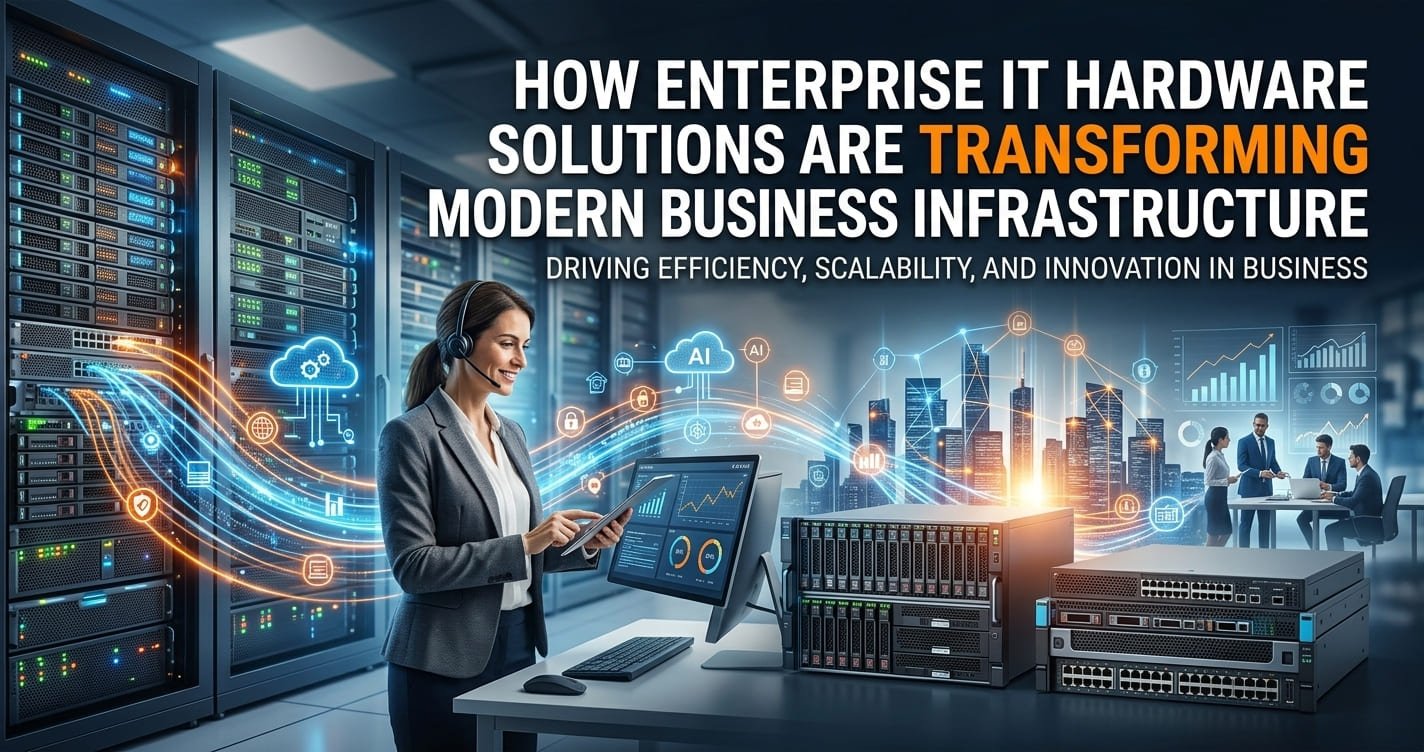
Modern businesses rely on technology for almost every aspect of their operations. From communication and cloud applications to cybersecurity, data storage, and remote collaboration, organizations need reliable IT infrastructure to keep their businesses running efficiently. As companies grow, their technology requirements also become more complex, making the right enterprise IT hardware solutions essential for long-term performance and scalability.
Businesses today are no longer looking for individual hardware products alone. They need complete technology ecosystems that connect networking, computing, storage, security, and business applications. A well-designed IT infrastructure can improve productivity, strengthen security, reduce downtime, and give organizations the flexibility they need to adapt to changing business demands.
Companies such as ORM Systems help businesses address these requirements by providing IT hardware and technology solutions designed around modern enterprise environments. ORM Systems offers networking hardware, servers, computing devices, storage and memory solutions, security and surveillance products, and networking accessories, while also providing broader IT services for organizations.
Why IT Infrastructure Matters for Modern Businesses
IT infrastructure forms the foundation of a modern organization. Employees depend on computers, networks, servers, applications, and data systems to perform their daily responsibilities. If these systems are slow, unreliable, or poorly integrated, even simple business processes can become inefficient.
A strong infrastructure allows businesses to create reliable connections between employees, applications, devices, and data. It can also support business continuity by providing dependable systems that remain available when organizations experience increased workloads or unexpected technical challenges.
As businesses adopt cloud computing, artificial intelligence, remote work, cybersecurity technologies, and data-intensive applications, their infrastructure must be capable of supporting these technologies. This is why choosing the right hardware and designing an appropriate IT environment has become an important strategic decision rather than simply an operational task.
Networking Hardware Creates the Foundation
Networking is one of the most important components of enterprise infrastructure. Every connected device within an organization depends on a reliable network to communicate and exchange information.
Network switches help connect devices within an organization, while routers manage communication between different networks and provide connectivity beyond the internal environment. Businesses with demanding workloads require networking equipment capable of handling significant amounts of traffic without compromising performance or reliability.
Modern networking infrastructure also needs to support scalability. As an organization adds employees, offices, devices, applications, and cloud services, its network must be able to accommodate that growth.
High-quality switches, routers, and networking accessories can therefore contribute to faster communication, better network management, and improved operational reliability.
Servers Support Critical Business Operations
Servers remain an essential component of many enterprise environments. They can host applications, manage databases, store information, support virtualization, and provide centralized resources for employees and business systems.
Choosing the appropriate server infrastructure depends on factors such as workload requirements, processing power, storage capacity, scalability, virtualization requirements, and security.
Organizations handling demanding workloads may require enterprise-grade servers designed for performance and reliability. At the same time, growing businesses need infrastructure that can scale as their requirements increase.
The right server environment can help organizations manage critical workloads more efficiently while providing the flexibility required for future expansion.
Storage and Memory Are Essential for Growing Data
Businesses generate and process enormous amounts of information every day. Customer records, applications, databases, documents, analytics, media files, backups, and operational data all require dependable storage infrastructure.
Storage solutions need to balance capacity, performance, reliability, and accessibility. Organizations may require different storage technologies depending on whether they are supporting databases, virtualization environments, file storage, backup systems, or other workloads.
Memory is equally important because insufficient memory can affect application performance and overall system responsiveness. As workloads become increasingly data-intensive, businesses must carefully evaluate their storage and memory requirements.
A well-planned storage infrastructure can help businesses manage growing data volumes while maintaining the performance needed for everyday operations.
Security Must Be Built Into IT Infrastructure
Cybersecurity has become a fundamental part of modern IT infrastructure. Businesses face increasingly sophisticated threats that can affect networks, devices, applications, and sensitive information.
Security and surveillance technologies can play an important role in protecting physical and digital environments. Organizations need to consider security as part of their broader infrastructure strategy rather than treating it as a separate technology requirement.
Network security, access control, monitoring, endpoint protection, backup systems, and data protection can work together to create a stronger security environment.
Businesses should also regularly review their security architecture because threats and technologies continue to evolve. A system that was suitable several years ago may not provide adequate protection for today’s infrastructure.
Cloud and Application Services Are Changing IT Strategies
Cloud computing has changed how businesses design and manage technology infrastructure. Instead of relying exclusively on traditional on-premise environments, organizations can combine cloud platforms with existing infrastructure to create hybrid environments.
Cloud migration can help organizations modernize legacy applications and improve flexibility. However, migration must be carefully planned to minimize disruption and ensure that applications, data, security controls, and business processes continue to operate effectively.
IT application migration and application innovation are increasingly important areas for organizations looking to modernize their technology environments. ORM Systems highlights services covering IT application migration, application innovation, cloud security, and ransomware protection as part of its broader technology offering.
Ransomware Protection Is Becoming More Important
Ransomware remains a major concern for businesses because an attack can disrupt operations and make critical data inaccessible.
Effective ransomware protection involves more than installing security software. Organizations need a broader approach that includes secure infrastructure, access controls, monitoring, backup strategies, employee awareness, and incident-response planning.
Businesses should also ensure that important backups are protected and regularly tested. A backup strategy is only useful if data can actually be restored when an incident occurs.
Modern IT infrastructure should therefore be designed with resilience in mind. The objective is not only to prevent attacks but also to help the organization recover quickly if an incident occurs.
Choosing the Right IT Hardware Partner
Selecting technology products from multiple vendors can become complicated for organizations managing large infrastructure environments. Compatibility, availability, warranties, deployment requirements, technical support, and future scalability all need to be considered.
An experienced IT hardware partner can help businesses evaluate their requirements and select appropriate solutions. This can be particularly valuable for organizations managing servers, networking infrastructure, storage systems, security technologies, and computing devices across multiple locations.
ORM Systems describes itself as providing IT hardware solutions and broader technology services for businesses. Its website also highlights global coverage across locations in the UK, USA, UAE, and the Netherlands.
Building a Scalable IT Environment
A modern IT environment should not only solve today’s problems. It should also support tomorrow’s requirements.
Businesses should consider future employee growth, additional locations, increasing data volumes, new applications, cloud adoption, cybersecurity requirements, and changing customer expectations when designing their infrastructure.
Scalability allows organizations to expand without completely replacing their technology environment. Modular networking systems, expandable storage, virtualization-ready servers, and flexible cloud infrastructure can all contribute to a more adaptable technology strategy.
The goal should be to create an infrastructure that supports business growth rather than becoming a limitation.
The Future of Enterprise IT Infrastructure
Enterprise technology is continuing to evolve rapidly. Artificial intelligence, cloud computing, edge computing, cybersecurity, automation, and advanced networking are changing how organizations operate.
Businesses will increasingly need infrastructure capable of supporting high-performance applications and large volumes of data while maintaining security and reliability.
The future of IT infrastructure will therefore depend on integration. Networking, computing, storage, cloud services, security, and applications need to work together as part of a unified technology environment.
Organizations that invest strategically in their IT infrastructure can position themselves to respond more effectively to technological change and business growth.
Conclusion
Reliable IT infrastructure is essential for businesses operating in an increasingly digital environment. Networking hardware, servers, computing devices, storage, memory, security technologies, and cloud services all contribute to the performance and resilience of an organization.
The right technology strategy can help businesses improve productivity, protect critical information, support employees, and prepare for future growth. Instead of viewing IT hardware as individual products, organizations should consider how each component contributes to the overall infrastructure.
With the right planning and technology partner, businesses can create scalable, secure, and reliable IT environments that support their current operations while preparing them for the future.
Frequently Asked Questions
What are IT hardware solutions?
IT hardware solutions include the physical technology products businesses use to build and operate their IT infrastructure. These can include servers, routers, network switches, computers, storage systems, memory components, security equipment, and networking accessories.
Why is enterprise IT infrastructure important?
Enterprise IT infrastructure provides the technology foundation that businesses need to operate their applications, networks, data systems, communication platforms, and security environments. Reliable infrastructure can improve performance, reduce operational disruption, and support business growth.
What is the difference between a router and a network switch?
A router connects different networks and manages traffic between them, while a network switch primarily connects devices within the same network. Both are important components of business networking infrastructure.
How do servers help businesses?
Servers provide centralized computing and storage resources for organizations. They can support applications, databases, virtualization, file storage, business systems, and other workloads that require reliable computing resources.
Why is storage important for businesses?
Businesses continuously generate data, including documents, customer information, databases, application data, backups, and media. Reliable storage infrastructure allows organizations to manage this information while maintaining accessibility, performance, and data protection.
What role does cybersecurity play in IT infrastructure?
Cybersecurity protects networks, systems, devices, applications, and data from unauthorized access and cyber threats. Security should be integrated into the overall infrastructure strategy rather than treated as an isolated component.
What is cloud migration?
Cloud migration is the process of moving applications, workloads, data, or infrastructure from traditional environments into cloud platforms. Businesses may use cloud migration to improve scalability, flexibility, availability, and operational efficiency.
How can businesses prepare their IT infrastructure for future growth?
Businesses can prepare for future growth by choosing scalable hardware, planning network capacity, evaluating storage requirements, implementing strong security controls, considering cloud and hybrid environments, and regularly reviewing their technology strategy.
Why should businesses work with an IT solutions provider?
An experienced IT solutions provider can help organizations evaluate technology requirements, select compatible hardware, plan infrastructure, and implement solutions that support business objectives. This can simplify technology procurement and help businesses build more reliable and scalable IT environments.